
Turning emissions into strategic leverage
Reducing emissions. Lowering logistics costs. Improving last-mile performance.
Emission Eater helps logistics companies reduce emissions and operating costs through process improvement, last-mile innovation, and practical engineering solutions.
Logistics & Emission Eater?
The Geopolitical situation, global supply chain disruptions and increasing climate awareness are placing growing pressure on society. Industry faces new regulations, every year. In the Netherlands particularly regarding nitrogen emissions. The country is currently ranked among the poorest in Europe for water quality. These developments require governments to take action.
Dutch cities are transforming to improve quality of life. Industrial supply chains must adapt to these changes while absorbing the resulting cost pressures.
Twenty to thirty years after the introduction of the Toyota Production System, many companies are moving towards(highly) automated production and warehousing. This often moves away from the original philosophy of continuous improvement. If people are no longer involved in daily operations, how do you continue improving processes with limited investment? Automation can reduce flexibility. But could it mean that you have too many people on the wrong places?
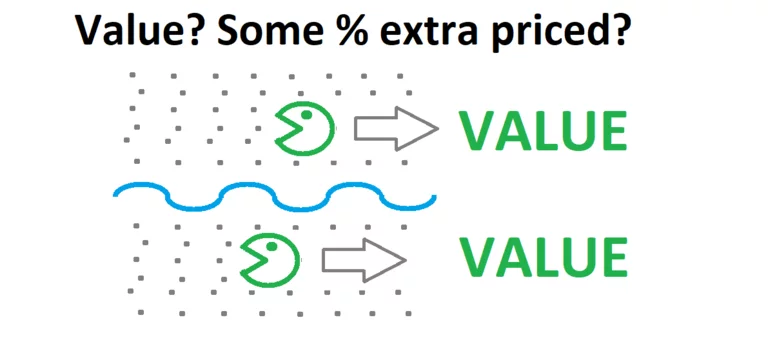
Value creation: you can create it
In marketing, respected columnist Mark Ritson has criticized companies for losing their focus on value creation. He argues that many marketing directors simply copy poor decisions from competitors. This suggests that genuine value creation is often seen as difficult.
A similar challenge exists in technology. Related to technology: Chief Technology Officers, may know what they want to achieve, but not know how to achieve it. As a result, companies often invest in expensive solutions offered by the technology industry, instead of identifying simpler alternatives.
Hidden problems? Micro management might give strategic advantage
Ignoring problems does not make them disappear. Over time,
organisations simply become blind to them.
Industry already has proven methods such as lean, 6-sigma and
zero defects. Companies understand how to listen to the market
and improve performance, but this requires time and the right
management tools.
Micromanagement at process level is essential to:
-to keep problems visible and identify practical solutions.
-improve customer satisfaction with relatively small investments.
- lead municipalities instead of simply responding to regulations.
Governments' attention towards emissions will continue to increase. A proactive approach can strengthen relationships with governments and municipalities while improving long- term financial performance.
Emissions and micro-plastics
People are increasingly concerned about plastics. Yet plastics themselves are not the real issue. The challenge lies in understanding and addressing the root causes of microplastics and nanoparticle pollution.
Once problems are analysed at their source, practical solutions
become possible. Doing nothing only increases the long-term
impact.
Managing emissions and microplastics can become the foundation
of a stronger competitive position.
Our offer / services
Green concepts to test
We offer practical solutions that help companies build a hands-on emission reduction infrastructure.
—Inventory supply chain risks
Assessing risks throughout your supply chain and last mile operations provides the insight needed to make informed decisions.
-Improve van or cargo bike performance: change mile to meter
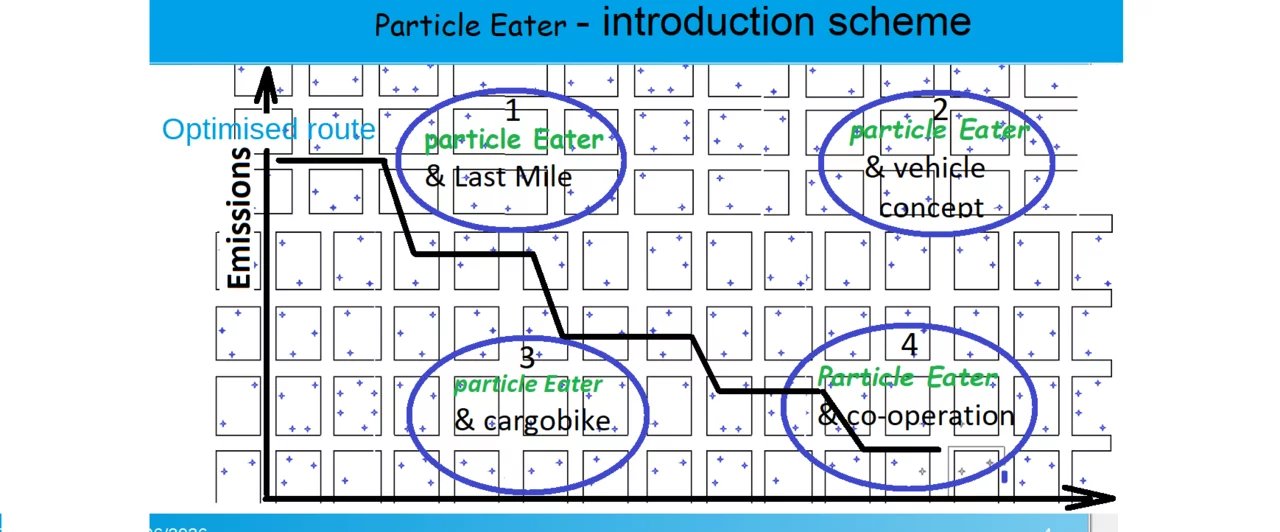
Our Last Mile(meter) innovation redefines the most polluting stage of urban logistics. . It improves the performance of vans and trucks while making cargo bike delivery commercially viable,, even in rural areas. The result is lower emissions and lower operating costs.
-Low friction vehicle
A new low-friction vehicle concept offers opportunities to restructure polluting transport while reducing both costs and emissions.
- software API: route optimisation, risks and emissions monitoring
Our API-based software optimises routes while monitoring operational risks and emissions, reducing both costs and environmental impact.
Our concepts combine practical methods, hardware and off the shelf solutions/software to support people-or robots- in performing their work more efficiently while reducing energy consumption and emissions.
Parcel logistics:: process improvements that reduce emissions, costs and network congestion.
Food logistics: greener supply chains with increased operational capacity.
particle Eater
turning emissions into a happier society
particle Eater is a last mile innovation developed to help address the growing challenge of(urban) pollution caused by transport.
particle Eater improves the performance of vehicle -and- courier combinations, including vans and cars, while also making cargo bike delivery commercially viable.
Supporting Software(API) enhances both the concept and the operational processes behind it.
Ambitious targets can deliver major improvements in performance and profitability.
Weak targets are often met with weak solutions- and those solutions can be expensive.
About us
We are a team of problem solvers with experience in production start up, mass production, small series manufacturing, quality improvement, process optimisation and tool engineering.
Our experience includes companies such as Toyota, Rank Xerox and Morton Airbags, covering industries including polymer processing, electronics, food processing and parcel logistics.
We are privileged to contribute practical ideas on challenging issues facing industrial logistics today. We believe that sustainable performance can only be achieved by maintaining a strong focus on the customer.
In 1996, Morton Airbags transformed its production system from automated manufacturing to manual production under Toyota’s supervision. At the same time the company sold the airbags across Europe at prices 25-50% below production cost. This forced continuous re-evaluation and improvement of every production concept in use.
What people say about us:
You are probably less interested in what people say about us..
You are interested in what you will say during the project.
- we will make that easy.
”It is more about what you will say”.
The data generated during your project will be valuable to other companies. They will want to understand your results and may wish to apply the same concepts themselves.
" Creating happy customers is still an art. We will give you some of the tools."